* names are changed as I did not ask if I could write about them.
Saturday, May 28, 2011
altruism while ignoring our own oppressions
* names are changed as I did not ask if I could write about them.
Tuesday, August 24, 2010
An ecological experiment with bamboo and pop bottles
Meanwhile the Transmillenium bus system, the multimillion dollar transport system never lets you on for less than the official price, imposing an altogether different culture of 'rights for those who can pay'. Several students have been run over and killed this year alone as they didn't have the money to pass through the barriers so instead tried to jump through the bus access doors. Students poured out of colleges on mass blocking the bus routes and demanding that a student price be introduced so that the city's poor students don't have to choose between eating, transport or risking their life. The response was the riot police but the political space seems to have been created for the debate.
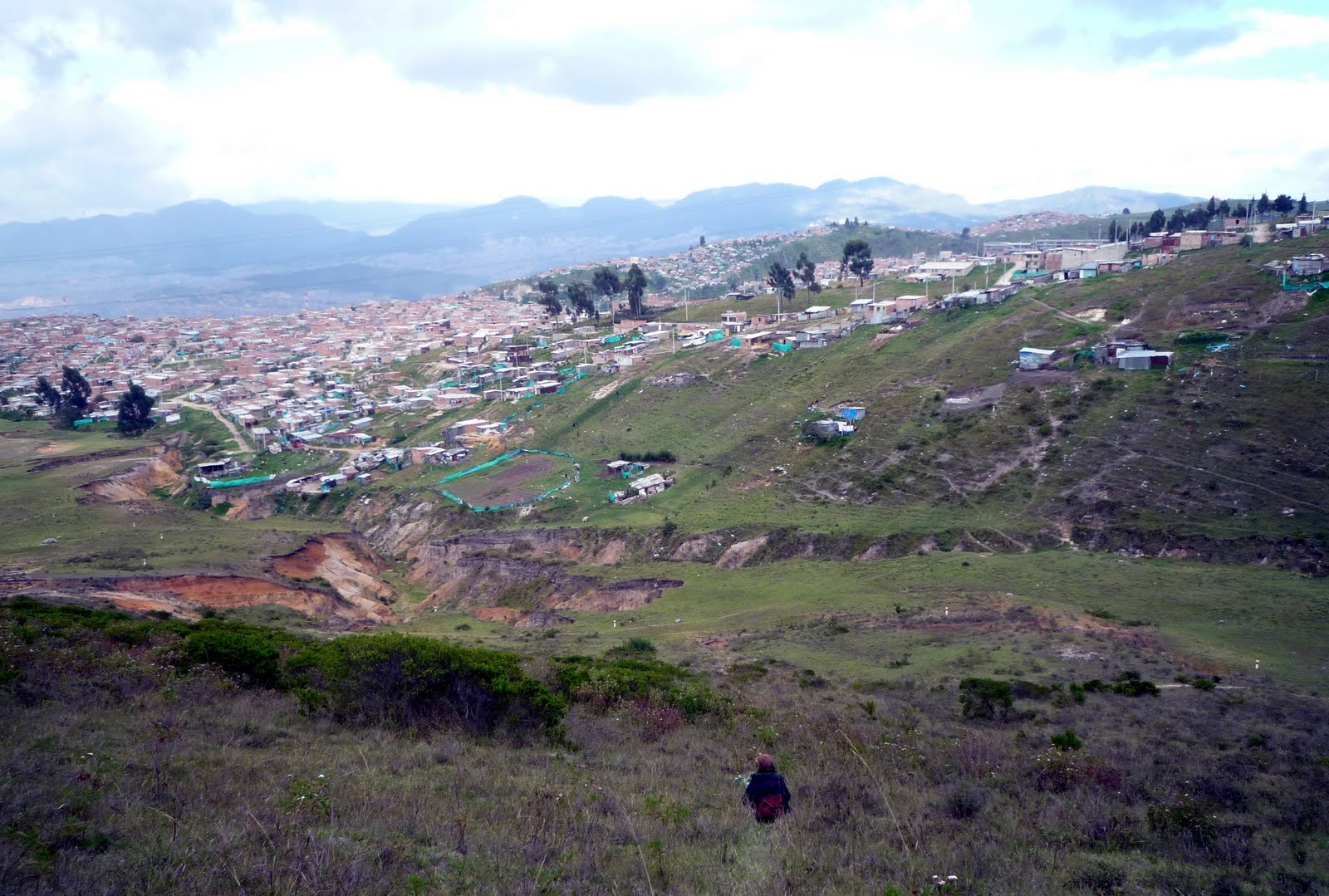
Back to our day out. We scrambled excitedly out of the bus at the end of the line and headed toward the plot of land. It is a plot right on the edge of the city, you only see fields and trees and most importantly you only breathe clean air, high up in the mountains above the smog level.
Wilson, a young lad from the organisation “Jovenes Proponen” -Youth Propose – from Ciudad Bolivar explains the project to us. “We want to have a place where young people can come and learn new skills, choose a different route in life to joining gangs and learn about the relationship between humans and our environment and how this capitalist way of building is destroying our environment, our home”
They are building a education centre out of guadua, clay mixed with horse shit and plastic bottles filled with plastic bags. Seven thousand plastic bottles roughly. The women from Paraiso got excited and inspired “so many of us had to work so hard to buy the bricks for our house, they are so expensive. If only we had known about another way to build.....”. They offered immediately, only to happy to help, to collect bottles to contribute to the project,
Local neighbours have been inspired by the project and have got involved, coming down to help with work in their free time. They proudly tell us how they have planted peas, potatos, peppers and lettuces and about their irrigation system, again using plastic bottles. In return the women from Paraiso introduced themselves and shared their thoughs:
“I like to be nosy and find out what is happening in other places, but not to be nosy for the sake of it but to learn new things. I am very happy to be here today” says Elvira
“For me it is very important that people are building again with bamboo and clay. That's how they build in my region. And it is a great idea to use the rubbish from this city so we don't have to exploit more natural resources” says Carmen
“It brings back memories being here, where I come from we used bamboo a lot. We used it to carry water in, and I use to hide avocados inside them” says Gratiniano. I didn't find out quite who he hid the avocados from.
Maria presents the women's project “We are a smallish but solid and determined group of women from Paraiso who want to organise ourselves so that we don't keep being exploited. We have a small allotment where we have strawberries and peas and arachacha planted and also we have a wormery so that we can make good compost from our waste products. If you wanted to come and visit us one day it would be good. So we can continue sharing experiences of how to produce food. Also it would be wonderful if we could come here and begin to cultivate some of the unused land around this plot.”
The land around the plot belongs to either Victor Caranza or Forrero Fetequa, we aren't sure which but we are sure that they are both part of Colombia's landowning class.
Colombia has one of the most unequal land distributions in the world, achieved through violent dispossession of the lands and wealth of first indigenous peoples and now also of peasant farmers and afro-colombian communities. At the end of 2009 there were up to 4.9 million internally displaced people (IDP) in Colombia, bringing it alongside Sudan as one of the two largest internal displacement situations in the world. In 2009 alone there was a reported 290,000 people displaced. This massive displacement has resulted in over 6 million hectares of productive land being abandoned by campesinos.
“The current Internal Displacement Situation situation has to be seen in the context of a historical movement of expansion by the land-owning elites, an agrarian and structural problem, complicated and compounded since the 1970s by drug-trafficking and the presence of large international corporations.” [1]
Using this land above the urbanised part of Ciudad Bolivar for growing food on would definately ease the problem of hunger but the land is earmarked as part of the Mining Industry Park, which will not ease problems of hunger.
As we walked back to El Paraiso the women commented to me how many of the houses, built from tin, plastic and wood, that we passed on our way home were not their a year ago. Signs of displaced peasant farmers trying to find a patch of land where no one will violently kick them off.
[1] Internal Displacement Monitoring Centre
Monday, June 21, 2010
Acknowledging our Wealth amisdt the Poverty: A Step to Stop Pillage

They responded naming air, the soil, land and water. Maria and I listened worriedly, it was as we had feared. The 30 women who came from various different neighbourhood groups did not know or acknowledge the huge amount of wealth there is in their district. The Environmental Forum had organised this tour around the district to explore what the impact of seeing this wealth with their very eyes would be, following the practice of Popular Education.
We boarded our bus and begin winding our way up the potholed roads, and as we gain more altitude the houses become more precarious and the barrios more controlled by paramilitaries.
We arrive at the first stop: Industrial Mining Park. Unluckily for the residents of Ciudad Bolivar they live on top of a enormous quantity of construction materials; sand, agregate, gravel and clay. After Holcim and Cemex rewrote part of the country's mining code, Colombia is now the only country in the world to allow open cast mining in urban areas.
The quarries have been condemned by numerous social organisations for the health impacts and the increased risk of landslides that they cause. The gravel pits, owned by Holcim and Cemex and following a 50km stretch of the River Tunjuelito, have destabilised the land and caused grave damage to the river ecosystem. Furthermore social organsiations that have spoke out against these megaprojects have suffered threats, assassinations and stigmatisation."We don't know where these materials are taken. Lots of trucks leave carrying the materials but we don't know where they take it, maybe for building works somewhere” comments Elmira.
Private companies extract the materials and sell them for the construction of Bogota, a city from which the residents of Ciudad Bolviar are excluded. “International capital is getting richer on our resources at the expense of us putting up with this shit situation; families without homes because of the mines and because of the huge inequality in Colombia, social control by paramilitaries to silence and weaken our grassroots organisations, hunger, bad health.....” says Maria angrily. The social and economic injustice is only too clear, and women receive the worst brunt of it, in their gendered role as carer of the entire family, highlighted by Carmen who described how she went without meals in order to buy her boy the medicines he needed.
Furthermore, the women were first excluded from influencing in the planning decisions around the operations of these mines, secondly they have been deceived in to believing that this wealth is not theirs and thirdly they have been kept in the dark around where the resources and profits from these resources end up. The tactics for preventing people from recognising their collective wealth are an essential part of the strategy to take these resources.
A similar situation happens in the United Kingdom where the elite landowners with the complicity of the British State have never revealed how much land they own so as to avoid demands for redistribution from the common folk. If we don't know and don't value the wealth we have, it is all too easy to take it without an outcry, such as what is happening with the Mining Park.
From the mines, we continued climbing the steep hill through densely populated barrios until suddenly we came out on to large extensions of open, barren land.
“While he is there in luxury we are here living in misery. Occupy y reclaim this land would be a good strategy. Land should be for those who work it... We would have to be very organised it to defend ourselves from the violent response by the state as it protects its interests. We know who they would send. All of this land is part of the Industrial Mining Pak which is why they don't let anyone squat this land. They are going to keep opening quarries and within 50 years this whole hillside will have been eaten away” replied Mario. Pointing to Paraiso, a barrio in the distance he continued “those of you live there are going to have serious problems soon. You are going to be in the middle of a quarry.”
The Paraiso compañeras fall quiet with thoughtful expressions. “These mines are wealth, but only for a few people, for everyone else they bring us social and environmental problems” concludes Luz Angela
The solemn moment is broken by Marisela enthusiastically pointing out a lake we are passing. “Look, look at the lake, would't it be amazing to be able to come here on Sundays." The lake is in fact the source of one of the many streams that flow down through Ciudad Bolivar, down through the quarries and into the River Tunjuelito. But the water up here is clear and clean.
With so much open green space near where they live, the women are frustrated that they do not have the freedom to enjoy the landscape, to rest and enjoy the peace and quiet, breathe clean air and forget the stresses of daily life. They do not have the freedom as the area is not very safe due to the paramilitary presence. The idea to organise a group outing is suggested.
We pass through the rural hamlet of Quiba and arrive at the village of Pasquilla, a campesino village within the City. We all notice the lack of cars and contamination as we eat our locally produced yoghurts in the main square. We watch the campesinos pass by wearing their traditional ruinas. “This is wealth too, that there are peasant farmers here using their knowledge of the land to produce food” observed Olivia.
Our next stop was the Doña Juana rubbish dump, the second largest open air rubbish dump in Latin America. The largest is in Sao Paolo, Brasil and communities there have formed organsiations to recycle the materials that arrive. Here 7500 tonnes of Bogotá's rubbish arrives daily and it is all dumped. They are dumping minerals and metals that are taken from communities at great environmental and social cost. Illogical but logical within a profit logic. Rubbish is big business, in Bogotá it is the most expensive public service. We discuss where the dump is wealth or a problem.
We arrive at the conclusion that like the quarries and gravel pits, the rubbish dump is “bad wealth because a few people profit while the rest suffer without any benefits.”
We leave the overpowering stench behind and move in to a new smell, that of mountain rain high in the clouds that surround the Regadera and Chisaca reservoirs.
The public water company provides all of the water for Ciudad Bogota from these two reservoirs. We shelter from the rain under a huge tree to reflect over the tour and the wealth we have found along the way, to laugh and to share our food.
“there was a total lack of knowledge of what wealth we have, we now know what our wealth is”
“we have a lot of wealth, we have seen and named it, we are not poor, we just don't benefit from it”
“we have allowed ourself to thing that this is not ours and so we haven't empowered ourselves to make demands”
“we have to organise ourself so that we can discuss, propose and make demands about the use of our wealth. But we need a lot of people, each one of us should go home and share what we have learnt with our children and our neighbours, those who it is safe to do so with.”
“Organising will bring us problems, it will but we have to do it, we have to value our territory”
“We have to work in community, educate ourselves and strengthen our womens networks so we can demand our rights are respected.”
As we wind our way home, the words of Mercedes Sosa accompanies us.... listen here
Monday, May 24, 2010
A conversation with marginalised women on the global politics of food
The skyscrapers in the centre of Bogotá become smaller and smaller as our bus winds its way up through the marginalised neighbourhoods of the grand metropolis. These are the neighbourhoods where you will find resting during the day the men who are forced to walk the city at night sifting through the rich mans “rubbish” or the poor mans “recyclable materials”. These are the potholed and unpaved streets owned at night by gangs of young lads, who are used and manipulated by the paramilitaries who have overall contol.
We are heading to the neighbourhood at the very top of the hill, La Estrella, where we work with several groups of women and young people on urban agriculture projects.
The theme for the workshop today is food sovereignty and autonomy, particulary relevent considering the recent signing of the free trade agreement between Colombian and the European Union. We make sense of the terms necessary for then being able to analysise what the radio is saying; imports, exports, dependency, “free” trade, import tariffs.
“To be dependent is to be like a slave and have to beg for food.”
“We don't want to be dependent on other countries for food because we are rich in products and we should give the opportunities to our producers.”
"free trade sounds pretty but the reality in the global markets is different. The big producers have many benefits while the small producers have none."
We talk about the decision on milk imports. I ask them what they think about the argument on the news that the powdered milk imports will mean that milk prices will drop and more poor children will have better brain nuerons. Olviria replies “it is true, milk is quite expensive at 70p a litre, but it is better that we support our milk producers as there are many many familes that survive from selling milk and what will all their children do?" Cleo adds “What is in this powered milk? Who knows what they will add? Milk fresh from the cow is the best, the healthiest.”
This conversation, a practice of popular education, makes me later think about the baby milk scandel, the practice by multinationals of aggressivly promoting powdered milk as better than breast milk to health care practioners and new mothers around the world. As far as I know this has not affected Colombia. Women here breast feed.
With imported powered milk now allowed in to Colombia in much greater quantities will it be followed by this manipulative life endangering practice?
Tuesday, March 9, 2010
Dominga: an unknown victim of EU "free" trade agreement
“Thousands of small milk producers, that are not able to access loans nor do they have leverage in high government, will suffer from an avanlanche of 5500 tonnes of powdered milk, 2310 tonnes in cheese and 1100 tonnes of other milk products those arrival in the country will increase by 10% annually until this vital part of the peasant economy disappears. Is this not about the human rights of thousands of peasant families?”[1]
Photo: Dominga leaving to take her cheese down to the main road, one hour away.
One of these families is that of Dominga, who I first met and wrote about in October 2008. I have been to stay with her several times since then. Darian is now living in the nearby small town where he can continue his studies. There is no secondary education in his hamlet. Cheese production pays for his transport, food and accomodation costs.
The last time I stayed with Dominga was in January. I told her about my good friend who has recently been sentenced for a year and a half after being found with two kilos of cocaine on him. He was doing the more risky job of carrying out the region as his two babies had rashes and he needed to buy medicines urgently.
She wasn't that sympathetic. “those lads in the
se coca areas just want easy money without having to do much work” I remember her saying. An interesting conversation around the kitchen table followed where we chatted about why we each thought that there had been a big increase in coca production in Catatumbo:
- paramilitaries imposing it as got 70% of their national revenue from cocaine in that one region
- twelve hour walks from many farms to just get to the road makes transporting yam or plantain very costly (you would need a lot of donkeys) for the price you would be able to sell it at while a kilo of cocaine in the rucksack is practically actually possible- lack of State support for peasant farmer agriculture
Photo: Milking her cattle, the daily morning work.
I wonder if Dominga will remember this conversation as she hears news of this threat to her livelihood. Will she have to turn to coca looking for a way to get food on the table and an education for her kids as the neoliberal policies continue to destroy peasant farming?
Thursday, January 22, 2009
We will win or we will lose but we wont accept the same
The strike is about to kick off as my alarm wakes me at 2.30am yesterday morning after a week of preparations with repeated meetings at 6am, 4pm and 8pm so people
By 5am the employees of Caves had stopped production in the three Drummond kitchens that feed 2000 workers and administration every day. They blocked entrances and prevented buses leaving the village to take the workers to work. The unionised workers do not work without a hot meal. Quickly the gringos are demanding that Caves go to the negotiating table to resolve this as quickly as possible.
Around 10am two rich gringo toffs arrive in the village to chat with the women. Apparently the agreement between Drummond and Caves was that all employees would receive new contracts
Advisors from Sinaltrainal arrived later in the afternoon and I was invited to come to the negotiating table. I worried that I would be perhaps, too frank. Having to listen to such insincere words in the morning got my blood boiling. The gringos accused the women of causing damage to the village and the region, which completely takes the piss when we are stood in a village with such poverty, with workers who earn pittance for working in dangerous conditions while Drummond makes $1.15billion a year. I set off to the mine with excitement, keen to learn how the dynamics of a negotiating table play out and to experience for myself what a 25000acre open cast coal mine looks like.
But nope, we were not allowed to enter the mine, nor was the food we had bought for the compañeros. I was hungry and started eating the food but with a bitterness in my mouth, knowing that I can eat in the village while those inside haven’t eaten all day. The negotiations go on until 2am; I’m unsure quite how they can debate for 8 hours when the demands aren’t complicated: direct contract with Caves for three years and an increase from the minimum salary.
I awake at 2.30am after 3 hours sleep to find out that Caves are offering direct contracts for one year, no increase in salary but recognition of the union which means they can negotiate over the coming year. We sleepily walk back into the centre, stopping for a quick coffee and enjoying the calm knowing that it is going to be another hectic day. Talk about this proposal continues as dawn arrives. Many of the women are unhappy. True that not being sacked but exactly the same working conditions is not something to celebrate or call a victory. I tell them that they have to make sure the negotiating team know how they feel, and if they want to continue fighting then they must tell people and not let the decision be made without their input.
At 5am a group decides they are going to block the road leaving the village to block the contractors’ buses. I accompany then yet we arrive to find 2 women already had the idea and the road is blocked. The new arrivals set about improving the blockade with branches, logs, concrete blocks while the contractors look on quietly: group of determined women saying with their bodies that we are not going to be treated like shit anymore and going to do all in our power to change this situation.
Discontent about the proposal on the table grows and the negotiating team is told not to sign anything without agreement from the three blockades. They arrived at the village a few hours ago, visibly exhausted after a night negotiating. Heated discussions in different groups began while a block of workers stayed sat under the shelter quietly. I urge the discussion I am present in to open this to everyone. After several efforts I succeed and we hold a spontaneous assembly. Marisela starts with an impassioned speech, no way is she moving until they win. Everyone present cheers and no one with a differing perspective is present. I step up to try and explain the different perspectives I have heard so that the compañeros can make a decision knowing the pros and cons of each.
The past two days feel a changing moment for me here in Colombia. For the first time I feel like the person I was in the UK. I have loved having these months to observe, listen, learn but it is fucking amazing to be able to get stuck in, spotting what needs doing and getting it done, chatting with people who look low, giving regular hugs to Lenis and ordering Polo to at least lay down for 5 minutes as he hasn’t slept in two days.
I´m unsure what I think is the right decision but crucial that the decision is made openly by those who are fighting with their bodies, so they do not feel let down by the union if the proposal was accepted without them nor bitter and angry if they lose their jobs.
An hour ago, they decided unanimously to reject the proposal and to endure the lack of sleep, lack of food, prospect of increased militrisation (8 riot vehicles are already parked in the village)lack of money for their families with the vision that they will win a better future for their families. They are well aware that with this decision they may lose everything, but then again they may just win……..
Monday, December 15, 2008
Dignity of Women - a women's space
In August 2007 she was released but is unable to live in Arauca. “They [the state] wouldn’t let me return. They would get rid of me again if I dared” she tells me. Yet last Tuesday we are on a bus together travelling to Saravena for the First Assembly of AMAR (Organisation ‘Awakening of Women in Arauca’) As the event unfolds I see what drives Raquel to return ..jpg)
Raquel was an outspoken and active member of the Teachers Union of Arauca for the twenty years before her arrest. It is as a passionate educator that her contribution to this assembly is really important to the growth of this young organisation (just 2 years old – very young in Colombian terms).
She tells me that in the assembly there is a session for exchange of experiences and wants me to speak. I ask S~ what she sees as the difficulties to participation in AMAR. Answer: choices controlled by jealous (or insecure?) husbands; societal pressure to be a ‘good’ wife and ‘good’ mother (so stay at home to cook, clean and bring up the kids), a cycle of women being told they have nothing to contribute outside of the kitchen, never learning new skills and thus reinforcing the myth that they are of no use; those who do break the cycle have their contributions criticised and undervalued. Constant battles with self-esteem
For many women just getting permission to attend the assembly is a big deal. A tactic used is to be very attentive to their husbands in the run up so they can get a pass out. Tellingly, the women who live this reality do not tell me this. A two-day event, with underconfident women is very little (compared to two-days with confident trade unionists) for building trust across differences.
I decide to share with them my community’s response to me being sexually harassed in Bristol. I had worries about doing this but decided to continue, and to also share the worries. I hoped they would contribute to building a space of truth and respect.
“I worry that what happened to me is so small that you will think why all the fuss. It is certain that far worse things happen to women in England and Colombia. But this does not cancel out the reaction that I had nor how it affected my daily life.”
I shared with them details of the harassment, how low level fear affected my and how it affected my confidence. I spoke about how if it wasn’t for the words and love of both informal and formal groups around me it would have been much harder; how my community took responsibility to hold him accountable for his behaviour.
“He wasn’t the enemy but every person has to take responsibility for the impact of their actions on others”.
This echoes the delicate path that AMAR are walking – holding men accountable for the violence within families yet clear that they are not the enemy. The women of AMAR wish to walk side by side with other social organisations, united against the violent policies of the government. It is already a hard task. They desire to build trust with men in the social organisations, showing them that that they are on the same side, build unity but just not ignore the shit the women have to put up with in their homes. Dignity for all, women and men.
“Alone, we are weak, our fears, insecurities overwhelm us. But together I had the strength and support to manage this situation. I see that AMAR can play a similar role for the women of Arauca. Creating a space where we can support each other, grow together, encourage each other, be gently critical without damaging our self-esteem. We must laugh together”
These were my honest words to these women. Speaking honestly with these women when I live such different experiences and priviliges is tough, it challenges me. I do not live surrounded by police, army, paramilitaries (who work alongside the army), and guerillas. When I share my perspective, shaped to encourage and support them, what accountability do I have to the suggestions I make? When I am told that to take action about an abusive neighbour is dangerous because you don’t know who they might be it reminds me how little I understand how this two decade long war over a land rich in oil weaves in to daily life.
But as I spoke, nods, laughter and smiles held my hand and gave me a squeeze of reassurance. And it is these nods and smiles, not just to me, but to every woman who shared a part of herself, that makes AMAR such a powerful, exciting and necessary organisation. It is this womens’ space, where quiet women come alive with hidden energy and enthusiasm when we started talking about ideas for projects, where Sa~ shares an inspiring story of how she managed to help another women find her dignity and leave her violent husband, where we can dance together to end the meeting, that draws Raquel back in to the fabric of an Araucan social organisation. ”Having to live in Bogota and work on a computer all day as a continued prison, a form of pyschological torture.” Here she feels and acts with vibrancy I had not seen before. So despite the police monitoring of the house where we were sleeping, despite the nervous hands which shows what her face has the strength to hide, I imagine we will be back.
Tuesday, November 18, 2008
Evolving rural life
That evening when Damien returns from school we study together, sharing new words, how to shape our mouths, tongues so the syllables sound right. As he, the sharpest and quickest english student I have ever met, writes ‘I like sheep, you like cows, we like pigs,…’ the sun sets and we switch on the bare light bulb.
It took twenty men from the community seventy working days to bring light to their farms. After many years of pressure, the council provided the materials. This was in 2004.
It’s so easy to see people living without amenities (running water, electricity, gas, roads, schools) as a permanent state and not recognise the sheer amount of hard hard physical work that has gone in to getting what they do have, nor to know of their plans for improvements for the future. Their time scale due is different – growing food and getting the money to pay for the materials must come first (no buy now pay later offers for a new bathroom - but change comes. And rather than just ‘home improvement’ change, they also have an idea of community improvements. Their next task is to dig drainage for the road to prevent it eroding away in the rains.
Education and collective organising are crucial to improving their lives. As Dominga told me “with education comes the confidence and skills to confront those in power who would otherwise ignore us.” With collective organising comes the capacity to improve more than just their homes and gardens, but their schools, roads, health access.….
Raul and I were there to help build some basic shelters for making compost for all in the vereda. The land, while lush and green, is not too fertile. I helped the men with the building - they didn’t comment on me doing such work, they didn’t say much to me. Shy – perhaps unsure of this strange person like Damien on the first morning. But with age – insecurities around difference are deeper, and it was tough for me to break through.
With Dominga, it took time too but through conversations while milking cows, making cheese together and washing up, we shared intimate moments. With me, she spoke openly about how her brother and husband ignore her opinion, yet later say she was right in the first place. She tells me she has had very little education, “women don’t need an education as they are only going to cook and look after the house and children" she was told..... I ask her how she has continued learning, despite being denied formal education. “I started recently going to meetings and there I have learnt a lot. I don’t speak but I learn. Some of the women think it is odd that I go to meeting but I tell them that we are as much a part of this community as the men”.
Our farewell suprises and moves me – we embrace for what feels like hours. She cries and tells me she loves me. I hold her dear to me. What do I mean to this kind strong woman? Why was my stay of just two days and two nights a profound experience for her? I hope I can return and spend more time with her, to find answers to these questions. For now I can only imagine.....
....that to spend time with another person with whom she could talk more openly (my gender was crucial for this trust to be built so quickly) is something she rarely has the opportunity to do as her imposed responsibility in life has been in the kitchen. Certainly not to talk and share ideas with others outside of her family.
This relationship prepared me a little more for the next part of my trip – participating in a workshop with a group of rural women, some of whom asked COS-PACC (the org. i was accompanying) for support in creating a women’s organisation so that ‘we leave from the kitchen’.
We did a few activities, intended to help them understand and reflect on their own situation in their community, and to start thinking of possible responses to their dignostic. I have my own views on what I think is really good about the rural way of life and what is not. But what I liked about the workshop was that the women from COS-PACC asked questions, instead of judging or being opinionated.
What did surprise me was how unique and rare the space created is and that the idea of the women of the community coming together every few months to eat, laugh, talk together is a powerful act for them. We left it in their hands. We could support them but they had to decide what they wanted and make the next step. I hope I go back there, as will mean that even though they were mainly pretty shy, that they enjoyed and valued the space and want to continue meeting.
Monday, November 3, 2008
Daughters of Slaves
The Afro-colombian students and young people I met at their National Gathering are very aware that they are the luckier ones, able to get an education and leave poverty, while the vast majority continue live in terrible conditions. They want to change this. It was a full on, powerful, intense, priviliged, exciting experience to be in the presence of three hundred Colombian students as they conversed "how will we create a positive transformation in the lives of Colombia’s black population".
After being delayed twice due to threats from paramilitaries and guerilla groups, the event took place in Buenaventura. Four days of debates, analysis, heated discussion. Daily my mind got too full of new thoughts for me to think any more and my notebook crammed full of reflections. Dancing was a welcome respite at the end of long days where I quietly observed and pondered the debates.......
How to we break Eurocentric control over culture, education, economics? How do we decolonise our minds, our institutions? Is Afro-centrism a good response?
Should our political position reject both left and right wing positions as they are both Euro-centric concepts and have been historically racist? Or can we build alliances with the left, yet maintain our identity and challenge racism.
Is the indigenous struggle over land rights also our problem as Afro-Colombians? How is capitalism and racism connected? How can we demand reparation for the work our ancestors have done?
Is learning about pre-slavery african history important for us in our present situation? Does the term multiculturality mean we are respected but still not included? How about Interculturality?
Outside, taking a break, I met a group of young woman, whose dads’ have been on strike for over 7 weeks and I asked if they would share with me their perspectives. They told me their families’ stories, passing, tugging and sharing the words out between them. We sat all together on the concrete ground. I seated myself carefully so we can talk as equals. I don’t want to interview them, rather hope they take the space as their own, to tell their own story.
Our relationships with our dads are difficult. We rarely see them. They leave for the sugar cane plantations at 5am and get home between 8 and 10pm. At school we were sometimes asked to do projects about our dads but this was nearly impossible. It is only when they have accidents that we see them more. “My dad lost his sight in his right eye”, “my dad had an accident with his leg and couldn’t work for six months – he got sick pay for three months”, “my dad has problems with his lungs from the dust“.
Things are really hard at the moment and we are going hungry because our dads have been paid for over six weeks. But I think the strike is just. They work like slaves in the fields cutting the sugar cane all day under the heat of the sun. Also, they are given protective clothing and a machete twice a year, yet the clothing lasts a month and the machetes just two weeks before they have to change it.
“I work from 7.30am to 6pm, 5 days a week doing housework. I get paid $230000 a month (£70). On Saturday’s I go to college to study nursery education. This costs me $100 000 a month.”
“I don’t have a job. I help at home. Because of the strike I don’t any money to pay for transport, or to print applications so it is difficult to look for a job.
If they win the strike, I will go to college to study nursing. I really want to be a nurse.”
On Sunday’s we all take part in a group [which organised for them to take part in this event]. Here, among many things, we talk about how to improve the relationships with our dads. They are sometimes violent at home.
“If I have an opinion it doesn’t matter to him because I am a women. If I do something, it’s often wrong, yet for my brothers it’s all good. I confronted my dad recently telling him this. He accepted it and we are talking more about this now.”
We want this, we want something better for ourselves, for our children.


(1).jpg)