Showing posts with label Ciudad Bolivar. Show all posts

Saturday, May 28, 2011

altruism while ignoring our own oppressions

Joyce is a shortish women with piercing blues eyes. She pulls up a seat next to me at the meeting in the working mens social club. I read her clothes and accent, working class. We are here to talk about how to fight back to prevent the rich from taking the little that remains of peoples means of survival. We begin to get to know each other with hushed conversations reflecting on what the bigger group is talking about.

We are talking about the divide between rich and poor on this island. She focuses her reflection, not on material wealth, but on relationships across class and how we get divided by them. She says with clarity “I wouldn't like to be rich because then the poor wouldn't like me”. A desire to live in a classless society because only then can we relate to each other as humans.

She was here, not because of herself “I am doing ok, I have a roof and my pension, I am getting by, but I came here to support my friends” pointing to two people she had came in with. She echos a sentiment I heard often in Colombia. Young women at a workshop in La Vega, Catatumbo, tell us how they are ok and they want to help the people less well off than them.


What is this pattern of people choosing to play down their own oppressions, to think they are ok and to be altruistic all about?

The altruism is uplifting. Rather than “charity which hands down from above” what both Joyce and the Catatumbero women seems like an “altruism that reaches across with solidarity and empathy”, as equals.

Playing down their own oppressions is to accept daily reality as it is, it is to not risk anything for fear of disappointment, it is to fear hope itself.

To name oppression is to dream of changing it. I ask the question against.

What is this pattern of us choosing to play down our own oppressions, to think we are ok and to be altruistic all about?

She goes on to tell me that she works as a cleaner a few hours a day. It is not worth the money she is paid but she enjoys doing it. She likes making the place clean. It gets her out the house. Again she does not question the shit wages which you can barely survive off for doing such an important job but rather she focuses on taking pride in what she does. Amelia, from Ciudad Bolivar, Colombia said the same. While society fails to value the cleaning work that her and Joyce and millions of other women do around the world through mass exploitation, on an individual level they strive to live with dignity by valuing it for themselves.

She shows me how I too have also been trying to create meaning and value, to be satisfied withh the work I have been doing in Health and Social Care at the council. I get why we do this. But valueing what we do each day seems to easily turn in to being satisfied with how things are.

I hope that young women in Colombia while valueing their role of keeping their family home clean can demand respect for the work they do and continue to push the boundaries of what their social role is. I hope that Joyce while valuing her cleaning work can demand respect from society for the work she does, which would be minimally reflected in better wages, and can have the opportunity to get out of the house to do other fun things. 

I hope I can value my skills assessing elderly and disabled peoples personal care needs and set up the care and support they need to have a dignified life while dreaming of being able to do this in a work place where my work is not so tightly controlled and monitored, and where I am not pressured to “save money”, words if more truthful would say “save money for the rich”. I am dreaming of us demanding that peoples needs must shape social services budgets, not the other way round.


* names are changed as I did not ask if I could write about them.

Tuesday, August 24, 2010

An ecological experiment with bamboo and pop bottles

Please carry us” shouted the women to the bus driver that went slowly past us heading up the dusty unpaved road. The laughter filled the air even as it looked like the driver wasn't going to let us on but then he signalled us to climb on through the back door. The ten of us piled on, amidst “god bless you” and numerous jokes about how he would be a good husband. Solidarity on the normal buses is ever present and they always let you travel for less than the official price and sometimes when near the end of the line, they let you ride for free.... all ten of us.

Meanwhile the Transmillenium bus system, the multimillion dollar transport system never lets you on for less than the official price, imposing an altogether different culture of 'rights for those who can pay'. Several students have been run over and killed this year alone as they didn't have the money to pass through the barriers so instead tried to jump through the bus access doors. Students poured out of colleges on mass blocking the bus routes and demanding that a student price be introduced so that the city's poor students don't have to choose between eating, transport or risking their life. The response was the riot police but the political space seems to have been created for the debate.

Back to our day out. We scrambled excitedly out of the bus at the end of the line and headed toward the plot of land. It is a plot right on the edge of the city, you only see fields and trees and most importantly you only breathe clean air, high up in the mountains above the smog level.

Wilson, a young lad from the organisation “Jovenes Proponen” -Youth Propose – from Ciudad Bolivar explains the project to us. “We want to have a place where young people can come and learn new skills, choose a different route in life to joining gangs and learn about the relationship between humans and our environment and how this capitalist way of building is destroying our environment, our home

They are building a education centre out of guadua, clay mixed with horse shit and plastic bottles filled with plastic bags. Seven thousand plastic bottles roughly. The women from Paraiso got excited and inspired “so many of us had to work so hard to buy the bricks for our house, they are so expensive. If only we had known about another way to build.....”. They offered immediately, only to happy to help, to collect bottles to contribute to the project,

Local neighbours have been inspired by the project and have got involved, coming down to help with work in their free time. They proudly tell us how they have planted peas, potatos, peppers and lettuces and about their irrigation system, again using plastic bottles. In return the women from Paraiso introduced themselves and shared their thoughs:

I like to be nosy and find out what is happening in other places, but not to be nosy for the sake of it but to learn new things. I am very happy to be here today” says Elvira

For me it is very important that people are building again with bamboo and clay. That's how they build in my region. And it is a great idea to use the rubbish from this city so we don't have to exploit more natural resources” says Carmen

It brings back memories being here, where I come from we used bamboo a lot. We used it to carry water in, and I use to hide avocados inside them” says Gratiniano. I didn't find out quite who he hid the avocados from.

Maria presents the women's project “We are a smallish but solid and determined group of women from Paraiso who want to organise ourselves so that we don't keep being exploited. We have a small allotment where we have strawberries and peas and arachacha planted and also we have a wormery so that we can make good compost from our waste products. If you wanted to come and visit us one day it would be good. So we can continue sharing experiences of how to produce food. Also it would be wonderful if we could come here and begin to cultivate some of the unused land around this plot.”

The land around the plot belongs to either Victor Caranza or Forrero Fetequa, we aren't sure which but we are sure that they are both part of Colombia's landowning class.

Colombia has one of the most unequal land distributions in the world, achieved through violent dispossession of the lands and wealth of first indigenous peoples and now also of peasant farmers and afro-colombian communities. At the end of 2009 there were up to 4.9 million internally displaced people (IDP) in Colombia, bringing it alongside Sudan as one of the two largest internal displacement situations in the world. In 2009 alone there was a reported 290,000 people displaced. This massive displacement has resulted in over 6 million hectares of productive land being abandoned by campesinos.

The current Internal Displacement Situation situation has to be seen in the context of a historical movement of expansion by the land-owning elites, an agrarian and structural problem, complicated and compounded since the 1970s by drug-trafficking and the presence of large international corporations.” [1]

Using this land above the urbanised part of Ciudad Bolivar for growing food on would definately ease the problem of hunger but the land is earmarked as part of the Mining Industry Park, which will not ease problems of hunger.

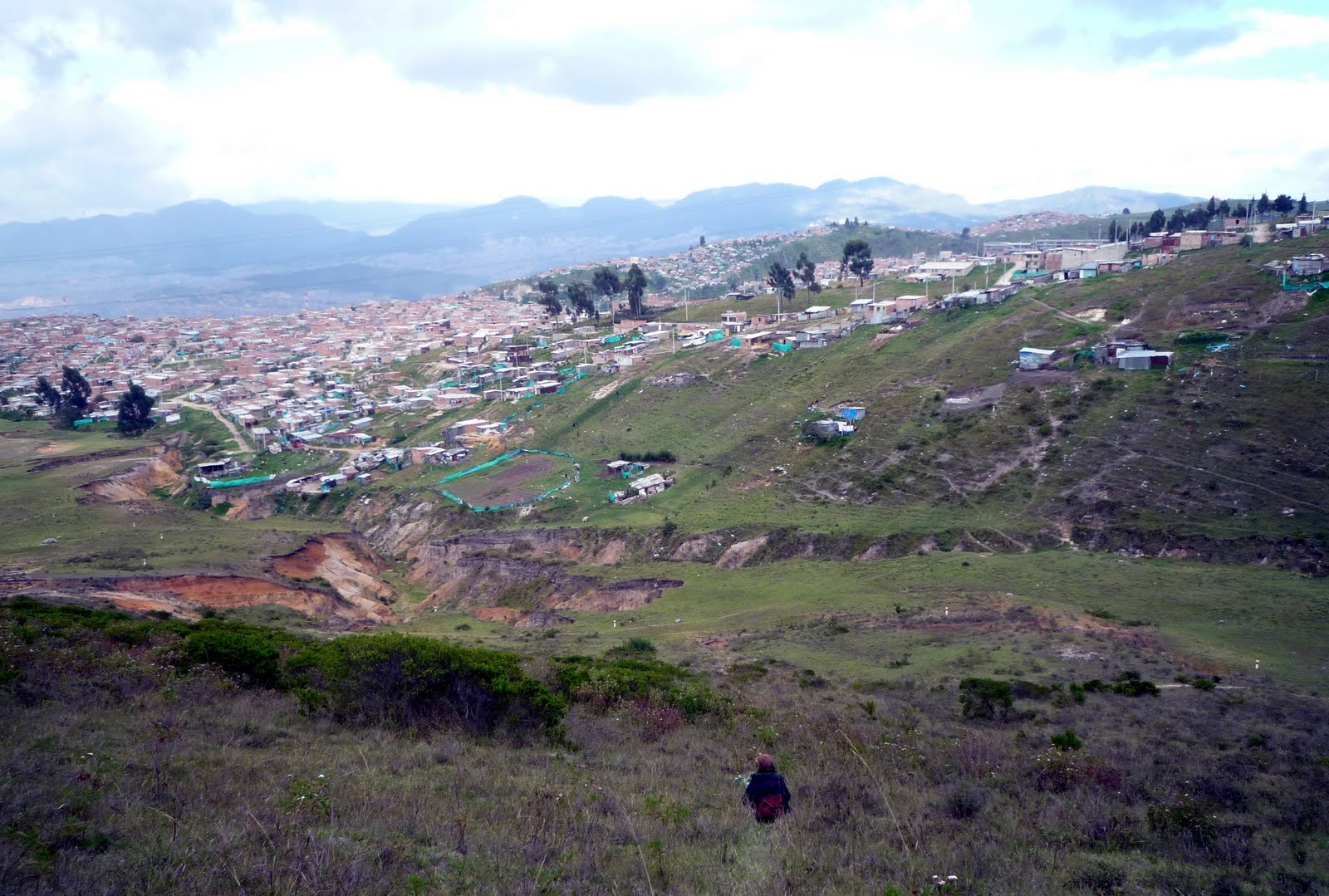
As we walked back to El Paraiso the women commented to me how many of the houses, built from tin, plastic and wood, that we passed on our way home were not their a year ago. Signs of displaced peasant farmers trying to find a patch of land where no one will violently kick them off.


[1] Internal Displacement Monitoring Centre

http://www.internal-displacement.org/idmc/website/countries.nsf/%28httpEnvelopes%29/7994964F3955C802C125719200585B76?OpenDocument